Showing posts with label pet. Show all posts

Tuesday, 10 November 2015

Why Dogs Love Bones

Why Dogs Love Bones

Seeing a dog chewing on a piece of bone is not something really special, even when it seems to get aggressive when disturbed. Dogs love bones. It is a fact. However, not only dogs, but all canines including fox, wolves, jackal, coyotes, dingoes, etc. enjoy chewing on pieces of bone, and they will bury these treasure in the ground to save that piece of delicacy for savoring later. Why do dogs love bones anyway? There are several answers for this question.

Firstly, dogs enjoy chewing on bones because those pieces are sources of nutrition. Dogs know that instinctively. Bone is a perfect food rich in calcium phosphorus and trace minerals. That way, dogs can remove plaque from their body. Besides that, chewing on bones make dogs happy due to the flowing of endorphins. This desire to chew on bones is very strong in dogs and all canines, thus when the natural urge to chew arises, they will start to chew on any hard stuffs they can find including plastic toys, shoes, or even table legs.

Secondly, it has something to do with evolution. Long before dogs are domesticated, their ancestors along with the ancestors of the other modern canines had developed a skull shape with strong jaw muscles and sharp teeth—it was around eight million years ago when open habitats were spreading through Asia, Europe and North America. Since the preys tend to group together so there will be more eyes to watch for a stalking predator, which is to protect themselves, ancient canines would need to hunt together as well so that they will be more likely to succeed in hunting. Hunting in pack was also the only way for smaller predators, including ancient canines, to snatch a very large prey. 

Slowly, after a few generations of hunting in pack, their jaws had become more accustomed to biting and holding on their preys. Thus, the modern dogs we see today love to chew—basically, it means biting and holding—on bones because it is simply a leftover evolutionary trait. In other words, predators with larger teeth and stronger jaws were more likely to hunt better, and to survive to pass on their large-toothed, strong-jawed genes to the next generation. It seems that living and hunting in packs coincided with a shift in dogs' diets today.

The resulting evolution of their strong jaws slowly turned the ancestors of our domestic pets into hypercarnivores. Hypercarnivores are animals which have a diet that is more than 70 percent meat, with the balance consisting of non-animal foods such as fungi, plant, etc.. Let us say, they also prey at all stages of life for a variety of organisms. Some of those well-know hypercarnivorous animals are sharks, starfishes, salmons, all sorts of felines (e.g. cats, lions, tigers, etc.) and canines in its natural state.

Dogs love bones. However, are bones really safe for dogs? Is it OK to feed your dogs with raw bones? Is it OK to let your dogs pick any bone from garbage? That is indeed another case and we are discussing about it here.
If a dog's prayers were answered, bones would rain from the sky.
~ Anonymous

Related topics you may find interesting:
Via bbc, why. Photo: Freeimages.com/Vaughan Willis
Baca selengkapnya

Wednesday, 4 November 2015

Ayam Cemani, The Unholy Yet The Most Expensive Chicken in The World

AYAM CEMANI, THE UNHOLY YET THE MOST EXPENSIVE CHICKEN IN THE WORLD


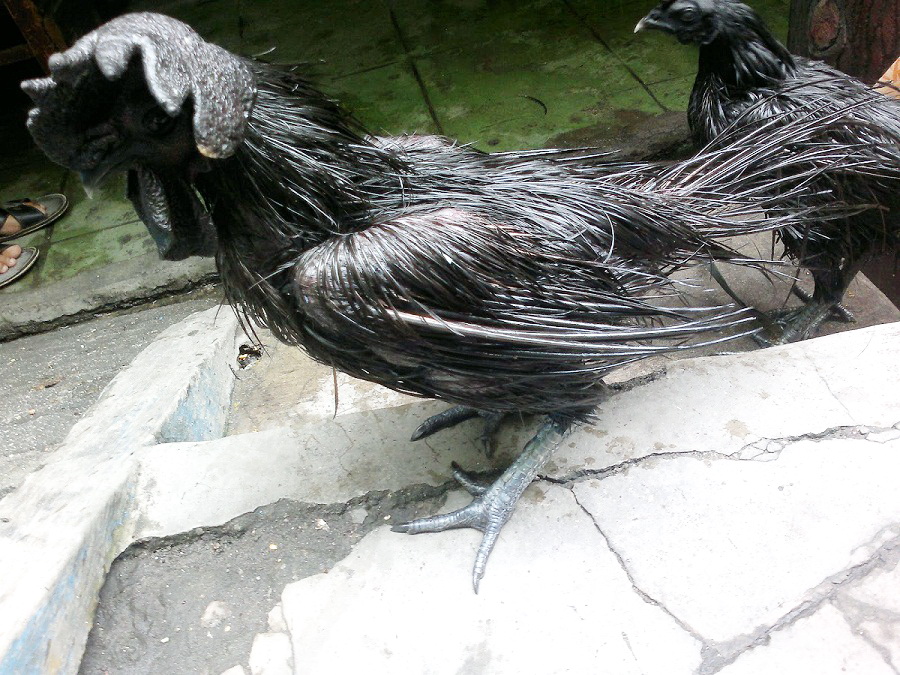
AYAM CEMANI, THE UNHOLY YET THE MOST EXPENSIVE CHICKEN IN THE WORLDIf there is an exotic chicken that will cost you more than $2,000 each, it is Cemani Chicken (or Ayam Cemani)—originated from Java Island in Indonesia—making it the most expensive chicken legally available in markets. The price is considerably high due to the rare availability outside of its native Indonesia and their being completely black: extraordinary ink-black feathers with a greenish shine, black legs, claws and toe nails, black beak and tongue, black comb and wattles; even their meat, bones and organs appear totally black except for their blood which is still red albeit extremely darker than a normal chicken’s blood.

AYAM CEMANI, THE UNHOLY YET THE MOST EXPENSIVE CHICKEN IN THE WORLD

The raven-black colour of the chicken occurs as a result of hyperpigmentation or excessive pigmentation of the tissues, caused by a mutated genetic condition known as fibromelanosis. This genetic condition is also found in some similar black chicken breeds such as Silkie (of China), Swedish Black (of Swedia) and Kadaknath (of India) although Cemani Chicken is considered the darkest of them all. “It is clearly the chicken of Our Dark Lord and Savior Satan!” said someone. Well, of course it was just an unusual expression of praise on the celebrated breed albeit Cemani Chicken being the “Lamborghini of poultry” as well. 

As traditional Javanese people are very fond of chickens, Cemani Chicken holds a special place in the culture for centuries and such breed receives special treatment. In some, if not many, cases, the pure black chicken are considered status symbols, good luck charms and are used in traditional medicine preparations to cure a variety of ailments. The chickens are even believed to have supernatural power and often used as offerings in a shamanic ritual. The black meat and its dark red blood—the darker the better—are favoured by unearthly forces they are trying to connect to, they said. Well, these occult practices can be rooted from the glorious days of the Majapahit Empire in the 15th century. But of course you do not have to be an occult practitioner to be able to enjoy the innocent and wonderful view of these majestic chickens on your own backyard. Cemani Chickens are robust, low cost, and by nature easy to handle, just like any other chickens.

Based on the comb type, Cemani Chickens fall into several categories as follow:

  • Ayam Cemani Wilah: single-combed 
  • Ayam Cemani Sumpel: pea-combed
  • Ayam Cemani Telon: pea-combed; splitting into three sections on top
  • Ayam Cemani Mahkota: rose-combed

AYAM CEMANI, THE UNHOLY YET THE MOST EXPENSIVE CHICKEN IN THE WORLD
Ayam Cemani Telon
Based on the feather, Cemani Chickens fall into several sub-breeds as follow:

  • Ayam Cemani: with all its common characteristics
  • Ayam Cemani Walik: with frizzled feathers
  • Ayam Cemani Rajeg Wesi (the Iron Feathers): with needle-like feathers
  • Ayam Cemani Putih: white-feathered Cemani Chicken
AYAM CEMANI, THE UNHOLY YET THE MOST EXPENSIVE CHICKEN IN THE WORLD
Ayam Cemani Walik
Based on the skin and tongue, Cemani Chickens fall into several categories as follow:
1. Ayam Cemani (the common breed of Cemani Chicken). As we may have acknowledged, the word “ayam” means “chicken” in Indonesian, while the word “cemani” means “completely black” in Javanese. The chickens that falls into this category have normal feathers, just like any ordinary chicken breeds, but with black feathers—all black. However, the colour of its tongue is rather grey, and not pure black.

2. Ayam Cemani Asli (the purest breed of Cemani Chicken). It has exactly the same characteristics as the common breed except for its tongue and blood which is black, or extremely dark (as the colour of its blood is still red in fact). Due to its being extremely small in number, the breed, if available, is usually sold at very fantastic prices, much higher than that of the common breed. However, several sources claimed that such breed with a pure black tongue and blood does not really exist.

3. Ayam Kedu (Kedunese Chicken). Being the ancestor of Cemani Chicken, it has the same physical appearance as Cemani Chicken except for the red colour on some parts of the body, including the comb, neck and buttock. Kedu is a region in Central Java where Cemani Chicken originated from centuries ago.


AYAM CEMANI, THE UNHOLY YET THE MOST EXPENSIVE CHICKEN IN THE WORLD
Ayam Cemani Rajeg Wesi
How to Breed Ayam Cemani
Instead of black eggs, Cemani Chicken lays normal cream-colored 45-gram eggs and it becomes the only part of the friendly bird that is not black. The hen lays up to 100 eggs on the first year. A typical laying cycle lasts for about 20 to 30 eggs, and then she will stop laying the eggs for 3 to 6 months. However, the distribution of black pigment in the offspring may vary. If you want to breed the bird, be aware that the hens are poor setters, and they rarely hatch their own brood so you may want to consider using incubators. 

So, what do you think about Ayam Cemani as the most expensive chicken you'll ever see? They do deserve a special spot among your lovely pets.

A drunken man was dreaming that he died and reincarnated on earth as a chicken. He became heavy and tried to lay an egg! He pushed and pushed and laid the 1st egg, then the 2nd. He was pushing to lay a 3rd egg when his wife screamed ''James! You're shitting on the bed!" ~ Anonymous
Via amusingplanet, carabudidayaternak; Photo: masterhias, gracefulchickens, cemanifarms, jf2013eks
Baca selengkapnya

Friday, 23 October 2015

Why Your Dogs Are Happy to See You

Why your dogs are happy to see you

Throughout history, dog is no doubt man’s best friend. They are the most loyal companions who will share their happiness with you. And anytime you walk through the door, you will see them wagging their tails insanely, sometimes overwhelmed with chaotic excitement. There is of course a scientific reason behind it, and it is not just because you are the one who feeds them everyday with your own hands. Let us see why your dogs are happy to see you now.

Using fMRI (functional magnetic resonance imaging)—while presenting certain items to the dogs and mapping their response—it was discovered that the temporal lobes in dog brains lit up "significantly more" when presented with faces than with objects. That implies that dogs may have the ability to recognize both human and dog faces. The research conducted at Emory University also shows that face recognition causes dog brains to activate in the same areas as in monkey and human brains. These areas are separate from the "reward areas" in the brain that would usually be triggered by anticipation of food. This fMRI result may suggest that dogs love their humans, and not just for food. They simply love the company of humans.

On further tests, it is also discovered that during abscence and then at rejoining with the owners, dogs’ behavior is very similar to that observed in children and mothers in similar situations. The abscence of or the separation from the owner is not voluntary for the dog as it is always unnatural for a dog to detach and abandon the pack. And humans are part of their pack, if not the pack leader. This insane level of happy greeting received by humans from their dogs is likely due to the fact that dogs do not recognize the possibility of non-voluntary detachment. Let us now imagine what it is like for a dog to be alone all day while we are gone. Unlike humans who can spend their being at home alone with all sorts of gadgets and activities of their choice, dogs will just sit, yawn, sleep, eat, run around and create chaos in the house. So in addition of being happy to see their owner, dogs are probably feeling some relief that they will do something interesting, such as going for a walk and having someone around. Inviting a dog walker or sending their dogs to daycare will be a good solution.

However, a dog’s particular greeting to humans depends on several factors, such as the dog’s temperament, the personality of the owner, the nature of their relationship, the level of stress and anxiety, and the dog’s capacity for self-control. And it is important to note that stress manifests differently in dogs than it does in humans. Moreover, licking you in the face is also a part of their social greeting. That way, dogs are trying to taste and smell you in the attempt to find out where you might have been and what you might have done during the time when you are not with them. Well, let us call it curiosity.

The other signs which indicate that the dogs are happy to see their owners are wagging tails and lifting eyebrows. The behavioral reason for these is that dogs can express strong social emotions (such as attachment and separation anxiety) to certain humans, such as their owners. They do not show such reaction for other things that may excite them, such as toys or food.

Below are several things that can trigger over-excitement or make your dogs "really" happy to see you:
  • Communicating with your dogs through words.
  • Treating your dog like a child.
  • Your dog is bored.
  • Acting like your dog’s playmate, not pack leader.
  • Being tense and nervous around your dog.

***

Read our related topics you may find interesting:
Why Dogs Bite People; Why Dogs Love Bones

Via abc7, io9, cesarsway; Photo: Freeimages.com/Kym Parry
Baca selengkapnya

Monday, 19 October 2015

Why Dogs Bite People

Why dogs bite people

There are strong reasons why dogs bite people, including children. And in some worst case scenarios, the attacks had also led to fatality. Training the dogs will prove useful to minimize any risks of getting bitten, but it will be better if we understand the reasons why people get nipped or bitten by friendly dogs, especially at home:
  • The dog is protecting something valuable or in its possessions, for example food, water dish, toy, territory or resting place, puppies (maternal instinct in this case), or even a person. Not only in guard dogs and herding breeds, such behaviors can clearly be seen in any dogs. It is a behavior that many humans really do not appreciate but is actually very normal for dogs.
  • The dog is afraid of strangers, for example postal workers, technician or any other unfamiliar visitors. Bites driven by fear can also occur when the dog is startled at home. 
  • The dog is injured or sick. The pain can drive any dogs to bite. Scheduling an appointment with a veterinarian could prove useful if injury or sickness is the real reason of why the dog bites people.
  • The dog is provoked by someone running or cycling near him/her position, resulting in a chase. Avoiding to cross path with a wandering dog on a street is a wise thing to do. But if the dog chases you, do not run. Stand still and avoid eye contact as this can be seen as a challenge— hopefully the dog will lose interest and sniffs at you and then walks away to find a new target. And in the worst case, if the dog chases and knocks you down, you have protect your heads, necks, and hands.

However, several other possible reasons of why dog bite people can be added if a child is bitten by the dog as below:
  • The child has provoked or frightened the dog, for example cuddling it, moving into its territory, stepping over it, taking something it. A provoked or frightened dog may pose some risks to the child.
  • The child has hurt the dog by stepping on it, poking it, or pulling its fur, tail, or ears. If not hurting, it can be startling the dog and provoking it to bite.
  • The dog is overly excited when both the child and the dog are enganging in a play. A playful dog can pose significant risks to the child. Even if the dog has no intention of harming the child, it may get caught up in the excitement of the chase and nip at children or knock them down.
  • The dog is of a herding breed and nips while trying to “herd” children. It is a normal and natural instinct, and not necessarily a learned behavior, especially for a herding breed. And the more people react to being herded by running, yelling, or else, the more likely the dog will be thinking of it as a fun and entertaining game.
  • Children are generally not very good at reading signals that a dog is trying to guard his possessions, for example placing its paw on top of the items and growling before the dog bites. As we know, most of them give clear warning before the dogs bite people.

***

Read our related topics you may find interesting:


Baca selengkapnya

Recent Posts